
Global trends, macroeconomic data announcements and the start of the earnings season would be the major drivers for the equity markets in a holiday-shortened week, analysts said. Equity markets will remain closed on Thursday for Eid-Ul-Fitr. Trading activity of foreign investors, rupee-dollar trends and crude oil prices would also guide trends in markets.
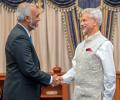
The avoidable stresses and strains in ties helped in one way. It showed for the entire region how a matured India handled diplomatic relations, especially with a smaller and suspicious neighbour, with practised dignity and patience, unruffled by provocations in word, deed and action, observes N Sathiya Moorthy.

'Some of the astounding proposals, if translated into statutory provisions, would be suicidal.' 'This would not be a wonder cure for increasing insurance penetration and only result in mushrooming growth of players like paan kiosks with deleterious consequences.'
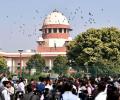
'A rigid or overly broad interpretation could lead to a chilling effect on investments and growth in sectors traditionally driven by private initiative.' 'Entrepreneurs may fear that their assets could be arbitrarily appropriated by the State under the guise of serving the 'common good' without sufficient legal safeguards.' 'The judgment thus supports a more nuanced view, one that balances individual property rights with public welfare objectives.'

The government on Tuesday announced setting up of hubs to promote exports through e-commerce medium in public-private-partnership (PPP) mode and initially 10-15 hubs will be established. Finance Minister Nirmala Sitharaman said that these hubs, under a seamless regulatory and logistic framework, will facilitate trade and export-related services under one roof. "To enable MSMEs (micro, small and medium enterprises) and traditional artisans to sell their products in international markets, e-commerce export hubs will be set up in PPP mode," she said.

The Adani family, led by Chairman Gautam Adani, is the most valued first-generation family business at Rs 15.44 trillion.

'Two consecutive quarters of negative growth are the technical definition of an economic recession, and for the first time in this generation's memory, we may be staring at one,' observes Aakar Patel.
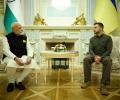
Ukraine and Russia need to engage with each other to find a solution to the ongoing conflict between them, India said on Friday after Prime Minister Narendra Modi held wide-ranging talks with President Volodymyr Zelenskyy in Kyiv under the shadow of the raging war.

There was no smooth surge in middle class prosperity for foreign businesses to tap into because of the Indian economy was mismanaged, argues Debashis Basu.

For Yogi Adityanath the successful management of the fair is a crucial part of building 'Brand UP' and making the state a $1 trillion economy.

Salaries in India are expected to increase by 9.5 per cent in 2024, slightly lower than the actual increase of 9.7 per cent in 2023, largely in response to market dynamics, according to global professional services firm Aon plc. According to the firm's annual salary increase and turnover survey 2023-24 India, that analysed data across 1,414 companies from almost 45 industries, salary increase in India seems to have stabilised at high single digits, after the post-pandemic high increments in 2022. "The projected increase in salaries in the Indian formal sector indicates a strategic adjustment in response to the evolving economic landscape.

Hasina was set to travel to London from India but is now contemplating other options after the British government indicated she may not get legal protection in the UK against any possible investigation, they said.

Addressing reporters at his residence soon after the meeting ended, Chowdhury said six names came up before the panel for the selection of the two ECs and the names of Sandhu and Kumar were finalised by a majority of members of the high-powered panel.

IT and interest rate-sensitive bank, realty, and auto stocks ended with sharp gains.

The US needs to understand that it could potentially lose out on attracting several Netravalkars in the future if it curbs the influx of such industrious Indian immigrants, argues Vishal Menon.
The Reserve Bank of India on Friday revised upwards the GDP growth projection for the current fiscal to 7.2 per cent from 7 per cent on rising private consumption and revival of demand in rural areas. Unveiling the bi-monthly monetary policy, RBI Governor Shaktikanta Das said estimates released by the National Statistical Office (NSO) placed India's real gross domestic product (GDP) growth at 8.2 per cent in 2023-24. "During 2024-25 so far, domestic economic activity has maintained resilience," he said, adding that manufacturing activity continues to gain ground on the back of strengthening domestic demand.

'...We should first look at and acknowledge what we have done to ourselves.' 'To not do so opens us to the accusation of rank hypocrisy and also reduces the stature of our globetrotting peaceniks,' asserts Aakar Patel.

Industry body CII on Thursday made a case for pushing reforms in sectors like land, labour, and agriculture by the Modi 3.0 government to accelerate economic growth, which is estimated to be around 8 per cent in the current financial year. CII president Sanjiv Puri said a lot of policy interventions in the past have put the economy on "a much stronger wicket". "The growth rate is poised to touch 8 per cent during the current year, marking the fourth consecutive year of above 7 per cent + growth.

'Opportunity for a country like India is huge in terms of wealth creation.' 'That's the reason India is an attractive economy for investors.'

Young Indian stars will be eager to usher in a new era in the shortest format with a series victory when they face Zimbabwe in the fourth T20I in Harare on Saturday.

Pakistan may want to undertake a 'false flag' operation in J&K to divert attention from the situation in Balochistan and Khyber Pakhtunkhwa but infiltrating one SSG battalion into J&K and having two SSG battalions waiting to follow suit means war, which Pakistan cannot afford in its current economic crisis, notes Lieutenant General Prakash Katoch (retd).

Broadly stagnant sales causes the first drop in business activity in over a year.

The top three industries in India susceptible to economic crimes are financial services, manufacturing and professional services

'As we enter 2025, it must be acknowledged that there is a convergence of capital, influential people (from business and politics) and technology deciding the destiny of others in the name of pride, patriotism, nationalism, nation building, all of it thinly veiled disguises for personal profit and glory,' asserts Shyam G Menon.

International oil prices continue to be extremely volatile, falling on one day and rising thereafter, a top oil ministry official said explaining the reason behind no reduction in petrol and diesel prices despite softening in input cost, but could not say if the rates will be cut before Maharashtra elections. Global oil benchmark Brent crude futures fell below $70 per barrel last week -- the first time since December 2021 -- but gained thereafter. Brent was trading at $74.58 per barrel on Thursday while West Texas Intermediate advanced to trade at $71.71.

PM Modi went to New York this time not to engage in polemics, but to find solutions to global problems. He made some progress on several matters, even on reform of the UN Security Council, when the US made a major concession for the first time that six permanent members without veto, including India, could be considered

'I don't think we have ever seen such alignment of everything that we need in the banking sector.'

Moody's Investors Service on Wednesday said the outlook for global banks for 2024 is negative as central banks' tighter monetary policies have resulted in lower GDP growth. It said Indian banks' profitability will increase further on lower provisioning expenses and robust growth in higher-yielding retail segments. "Our outlook for global banks for 2024 is negative as central banks' tighter monetary policies have resulted in lower GDP growth.


Hiring activity witnessed a 6 per cent year-on-year growth in March this year, supported by a rebound in economic activities and led by sectors such as banking and telecom, according to a report. However, there was a marginal dip of 2.4 per cent in hiring activity as compared to February, owing to the appraisal season, according to the Monster Employment Index (MEI). "Two years into the pandemic, it is heartening to see that the Indian economy has overcome setbacks and challenges with hiring momentum exceeding pre-COVID levels by 6 per cent this year compared to 2020," Monster.com, a Quess company, CEO Sekhar Garisa noted.
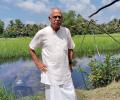
'Everything about farming is enjoyable and relaxing.'

In addition to Pichai and Nadella, IBM's Arvind Krishna, Micron's Sanjay Mehrotra, Ajay Banga from Mastercard and Ann Mukherjee from Pernod are among the six Indian-Americans among over 200 corporate honchos who will advise the President and offer recommendations on how to revive the American economy.
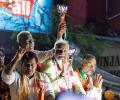
'We emphasise the importance of not basing investment decisions solely on electoral outcomes.' 'Instead, focusing on investing in high-quality businesses capable of prospering regardless of the political landscape is paramount.'

Sir Osborne Smith was the first governor of the Reserve Bank, serving from April 1, 1935, to June 30, 1937.

The Indian economy is likely to post better than anticipated growth in the second quarter (July-September) owing to robust urban consumption and expansion in services, a Business Standard analysis of high-frequency indicators showed. While gross domestic product growth in the September quarter is expected to come below the 7.8 per cent print in the June quarter due to a favourable base fading, analysts say the print will be much closer to 7 per cent than the 6.5 per cent anticipated earlier. While the Reserve Bank of India (RBI) had estimated 6.5 per cent growth for July-September, last month Governor Shaktikanta Das said the growth figure would surprise on the upside.

A senior Indian government official posted in Sri Lanka sustained grievous injuries in an unprovoked assault, the Indian high commission in Colombo said on Tuesday as it urged its nationals to remain aware of the latest developments in the island nation and plan their movements and activities accordingly.

Date, a 1990 Indian Police Service officer of the Maharashtra cadre who once sold newspapers in Pune to financially support his family, was honoured with the President's Police medal for gallantry for his role in what has come to be known as the 26/11 attack.

An increase in the farmer income support scheme PM Kisan Nidhi, the introduction of a 'robot tax' to fund reskilling of people who lose their jobs to artificial intelligence (AI), and a reduced income-tax (I-T) to bring relief to the middle classes - these are some of the items in the Budget wish list submitted by Sangh Parivar affiliates to Finance Minister (FM) Nirmala Sitharaman. Representatives of the affiliates of the Rashtriya Swayamsevak Sangh (RSS), such as the farmer organisation Bharatiya Kisan Sangh (BKS); trade union Bharatiya Mazdoor Sangh (BMS); Laghu Udyog Bharati, which works for micro and small industries; and Swadeshi Jagran Manch (SJM), which works on economic and policy issues, met the FM and other officials over the last couple of weeks as part of the pre-Budget consultations.
